
Clothes Feel Stiff or Show Drying Marks: Review Support and Care
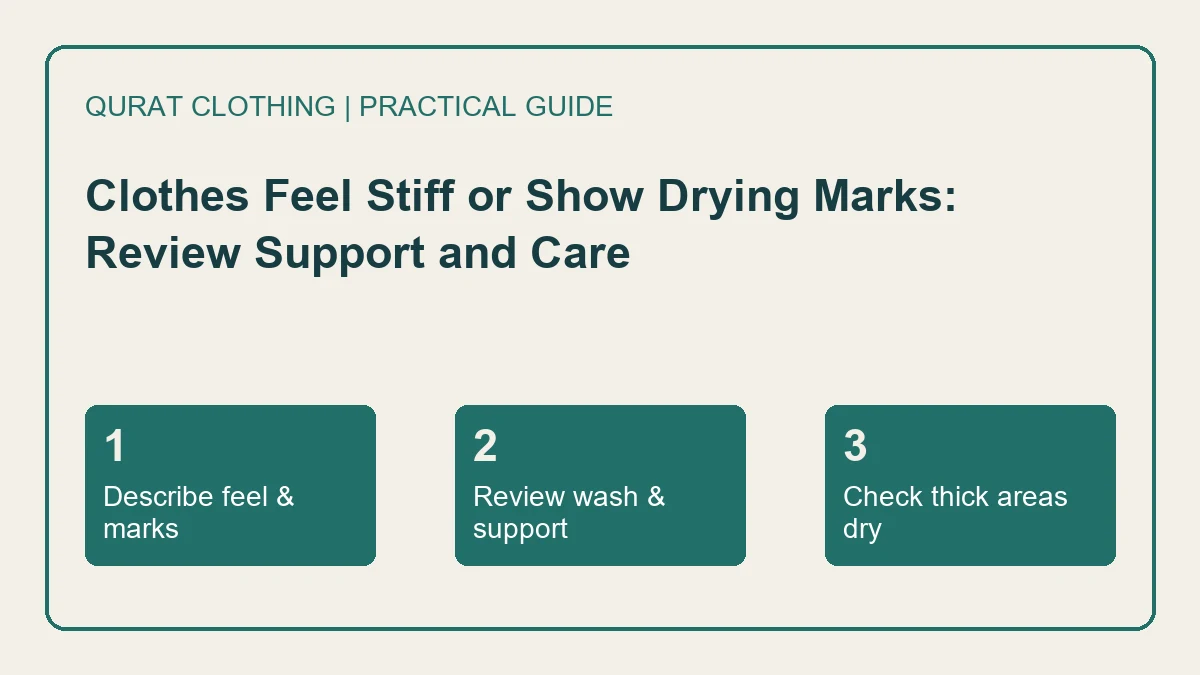
If clothes feel stiff or show marks after drying, separate the feel, the visible pattern and the drying arrangement. A rough hand-feel does not identify one cause, and a pale mark is not automatically detergent. Start with the care label and what happened during the actual wash and drying routine.
Record the observation without a diagnosis
Check whether stiffness affects the whole garment or one area. Look for a line from a drying support, a patch near a fold or a residue-like surface. Note whether the issue was present before the wash, after washing or only once dry.
Compare in consistent light and take photographs before applying another product. If there is a visible deposit, our white-marks guide explains why lint, residue and other changes should not be treated as identical.
Review washing before blaming drying
Read the detergent instructions, load arrangement and appliance guidance. Consider whether dosing, rinsing or another part of the routine needs review. Do not assume that adding softener is always the right response. It must be compatible with the garment, appliance and product directions.
If a mark appears only after drying, that timing is useful evidence but still not proof that the support caused it. A remaining deposit can become more visible as water leaves. Describe the timeline accurately when asking for help.
Check support points and airflow
Look at where pegs, a line, a hanger or a rack contacted the garment. A narrow support can leave a visible impression on some items. Follow the label's drying method and support the garment appropriately for its construction rather than stretching it to fit a convenient space.
Our limited-space drying guide helps plan room around garments. Avoid crowding items together so tightly that thicker areas remain damp. Do not place clothing against a heater or use an improvised heat source as a shortcut.
Let thick sections determine storage readiness
Check waistbands, cuffs, pockets and linings as well as the main body. An outer surface that feels dry does not establish that every section is ready to fold away. Store only when the item is fully dry by the permitted method.
For example, trousers may feel dry along the leg while a folded waistband still holds moisture. Leave the routine enough time to finish that area appropriately rather than sealing the garment in a storage bag. See the storage odour guide if an item has already been put away damp.
Choose a measured next step
Follow the care label and compatible product instructions if another rinse or cleaning step is appropriate. Do not repeatedly rewash at hotter settings on the assumption that all stiffness is removable residue. Stop if the surface or colour changes and seek an appropriate assessment.
For a new item with an unexpected condition, contact Qurat Clothing before alteration and keep the actual care history. The return policy explains eligibility. When replacing clothing from current boys', girls', men's or women's categories, compare both fit and the drying routine available to you. No fibre name alone guarantees a particular feel after every wash.
Marks follow the drying arrangement
A garment has lines where it rested on a drying support. Another part feels stiff, but the buyer cannot yet tell whether the feel and visible line are the same issue.
| Record | What to compare or ask |
|---|---|
| Pattern | Record where the marks sit relative to support points. |
| Feel | Describe the affected area separately from colour. |
| Care record | Keep washing and drying details together. |
What this example helps you decide
A support line, residue and a change in the textile surface need different consideration. Follow the actual label and avoid repeating a treatment solely because one observation has been given a familiar name.
For an item enquiry, include the QC code, selected size and the specific detail you need clarified. Keep an observation separate from an assumption, and retain any relevant photographs with your order record.
Comments
Be the first to comment.