
A T-Shirt Print Is Cracking or Peeling: What to Check Before Treating It
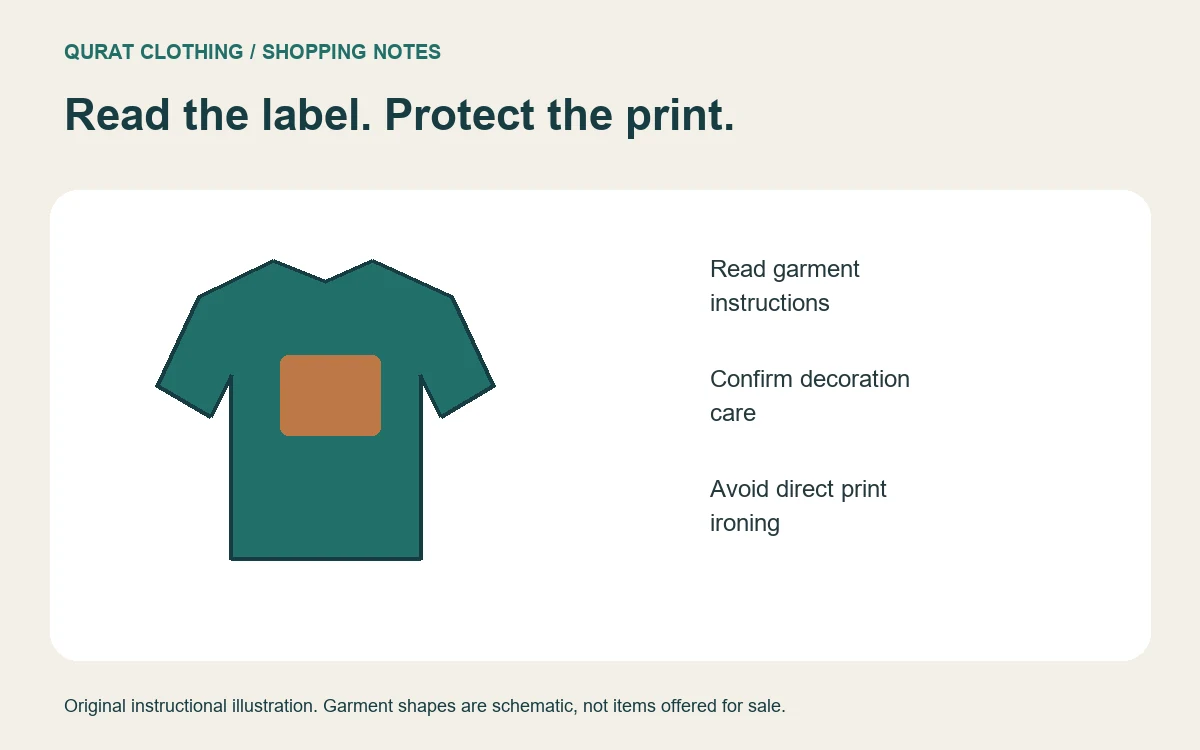
If a clothing print is cracking or peeling, record the condition and read the garment's care instructions before attempting a repair. Do not apply an iron, glue or solvent to an unfamiliar print. The printing process, fabric and original condition all affect what treatment, if any, is suitable.
A graphic T-shirt can be a favourite because of its design, so damage to that design can feel more noticeable than ordinary wear elsewhere. A measured first response is more useful than an internet “fix” that assumes every printed garment is made the same way.
Describe the change precisely
Lay the dry garment flat in good light. Is the print broken into fine lines, lifting at an edge, losing colour, or carrying a mark on top? Are the changes in one area or spread over the whole design? Avoid stretching the print to make a crack more visible: that changes the condition you are trying to understand.
Photograph the whole garment, the affected part and the care label. If the issue was present on arrival, keep the item unused and contact the retailer before washing or altering it. For Qurat Clothing purchases, use the current returns and issue-reporting guidance rather than assuming that a home treatment must be tried first.
A product photograph does not identify the printing method
Different decorative processes can produce a design that looks similar on a screen. A flat image may not establish whether the decoration is a transfer, direct-to-garment print, another printing process or something else. Embroidery and an applied patch require different checks again.
If the method is stated on the listing, record it. If it is not stated, ask whether specific care guidance is available. Do not infer a method from a brand name or from a slightly raised-looking photograph, and do not use instructions for another company's product as if they were the label for yours.
Use technical guidance within its actual scope
Printful's care guidance distinguishes its own printed product types. For its DTG and DTFlex apparel it recommends inside-out washing and avoiding direct ironing of the print, with process-specific washing and drying instructions. That is useful evidence that decoration can affect care; it does not identify the process used on a Qurat Clothing item or replace that item's instructions.
Keep the practical rule narrow: follow the complete garment label and any confirmed decoration-specific instructions. Where those instructions conflict or are unreadable, ask the retailer before selecting heat, chemicals or a cleaning service.
Review the previous routine without jumping to blame
If the garment has already been worn and washed, note what actually happened. Record the cycle, detergent, drying method and whether the printed area was ironed. “Machine washed” alone leaves out most of the useful detail, but an imperfect memory is not a reason to invent settings.
Also note whether the design was already intentionally distressed. Some graphics use a worn-looking finish. Compare the original listing and any arrival photographs, while recognising that a product image may not show every tiny surface detail. An intentional finish and a newly lifting edge are different observations.
Avoid improvised repair recipes
Pressing a peeling area with high heat may change both the print and the base fabric. Adding adhesive introduces another material whose compatibility you may not know. A solvent that removes a mark can also affect colour or decoration. Without product-specific instructions, these are experiments rather than reliable repairs.
If the piece has sentimental value, describe the material and decoration to a suitable garment-care or repair professional. Ask what outcome is realistic before agreeing to work. A successful cleaning step does not necessarily restore a damaged print, and no routine can promise that a design will remain unchanged indefinitely.
Plan the next wash before starting it
Read the label at the point of use, not from memory of another T-shirt. Check whether the instructions cover the whole garment and whether any decoration note is present. Select the allowed washing and drying methods, and keep the garment away from treatments the instructions prohibit.
If a household shares laundry duties, leave a clear note with any piece needing different care. A short instruction based on the label is more useful than a general “delicate” label that everyone interprets differently. Qurat Clothing's general garment-care guide can help organise the wider routine.
Buy a graphic for the garment as well as the design
Before buying another printed top, compare fit, composition, condition and care. A design you love is more useful when the garment also suits your normal washing arrangements. Check close photographs and ask about unclear decoration details before placing the order.
Explore current boys' T-shirts and shirts or girls' T-shirts and tops at Qurat Clothing, then read the specific listing. Category membership does not establish a printing method or a care guarantee.
An example of a useful care note
For a child's graphic top, a household note might record the product reference, the readable label instructions and a reminder to check the decoration before ironing. It should not claim a printing method that the seller has not confirmed. If the top later develops a lifting edge, add the date and an unedited photograph rather than replacing the original note. That small history makes it easier to explain what changed, what care was used and which questions still need an answer from the retailer or a professional.
Keep the first response simple
Document the change, protect the item from further experiments and confirm the appropriate care route. That gives you a better chance of making a useful decision than trying to reverse an unfamiliar print problem with heat or chemicals.
A print has a fine line and a lifting edge
A printed T-shirt shows a fine line across part of its design and a separate edge that appears to lift. The wearer needs to record each feature before deciding whether any treatment is appropriate.
| Record | What to compare or ask |
|---|---|
| Arrival or later | Say when the feature was first observed. |
| Close-up and context | Show the whole design and the specific area. |
| Care and treatment | Keep the actual label and any washing, heat or product history. |
What this example helps you decide
A visible line, peeling edge and an intentionally distressed design are different possibilities to clarify. Avoid heat, adhesive or scraping based only on a general article. For a new-delivery concern, preserve the item and contact the retailer with its code.
For an item enquiry, include the QC code, selected size and the specific detail you need clarified. Keep an observation separate from an assumption, and retain any relevant photographs with your order record.
Comments
Be the first to comment.