
Is That Temporary Stitching? Check Before Cutting Threads on New Clothes
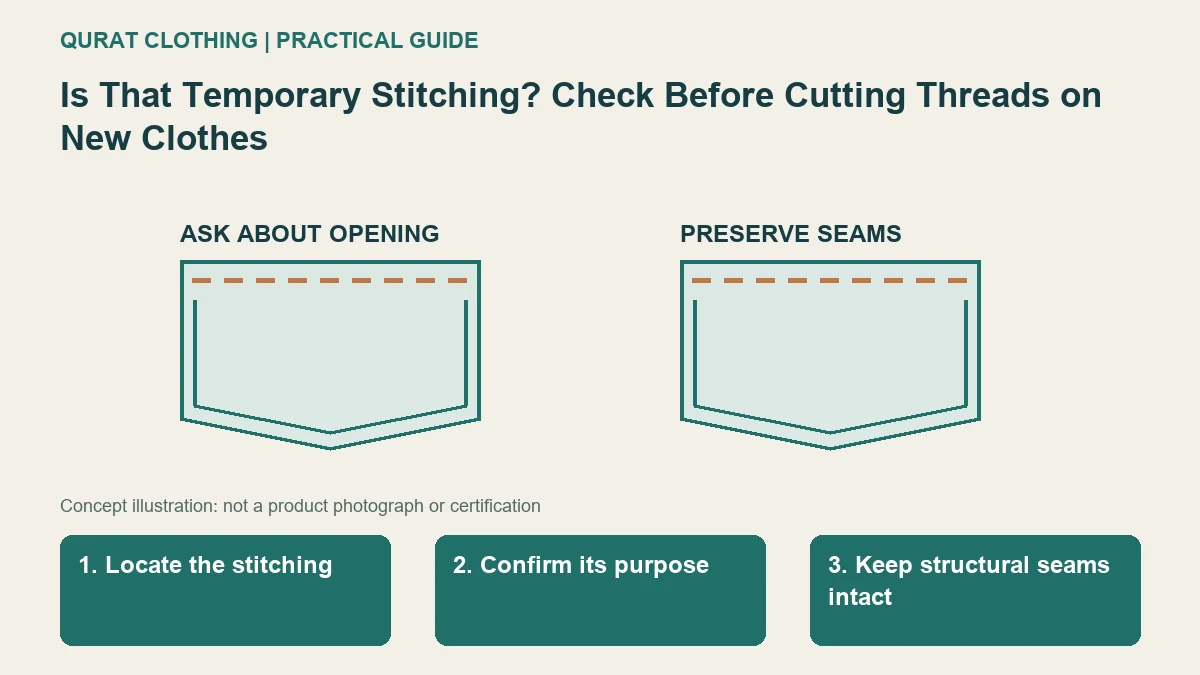
Some new garments contain temporary stitching, but an unusual or visible thread is not automatically meant to be removed. Before cutting, establish what the stitching holds together and what the maker or retailer says about that exact detail. A pocket opening, decorative line and structural seam are different things to assess.
Record the location and what the thread connects
Lay the item relaxed and look at the whole area. Is the thread across a pocket opening, joining two fabric panels, securing an attachment or visible at a decorative detail? Take an overall photograph and a close view before changing it.
A long stitch or a contrasting thread can prompt a useful question, but neither proves that removal is intended. Do not pull a thread until something opens as a way to identify its purpose. That test alters the garment before the question is answered.
A stitched pocket needs confirmation of its construction
Some manufacturers use temporary support stitching at certain pocket openings. For example, FIGS explains basting on specified products in its own range. That is an item-specific example, not permission to cut an unknown pocket on another garment.
Check whether the listing describes a functional pocket, whether the inside construction is accessible without opening seams, and whether the seller can confirm the intended opening. A flap or a pocket-shaped design on the outside does not establish that a usable pocket bag exists beneath it.
For example, if you need a working chest pocket and the photographs show only the outside, ask before ordering. Do not buy a decorative feature on the assumption that cutting one line of stitches will turn it into the pocket you need. Our pocket buying guide covers the function question separately.
A vent or decorative detail is a different case
An opening at a jacket back or skirt hem can have its own finishing arrangement. Inspect the listing and ask about the particular stitch rather than applying a pocket instruction to every opening. Two garments with similar shapes may use different construction.
Likewise, contrasting stitching can be part of the design. Check whether a line repeats intentionally across the item and what it connects. Removing a visible detail simply because it looks different can change the appearance or release a seam that was meant to remain intact.
Keep reinforcement and attachments out of the experiment
Stitching at pocket ends, belt loops, fastenings and joined panels may secure parts that need to remain attached. A dense or small area is not a reliable candidate for removal. If its purpose is uncertain, ask for an assessment without snipping it first.
For a thread near a loose button or damaged seam, use our repair assessment guide. A confirmed fault and a temporary support stitch require different decisions. Do not describe one as the other solely from a small photograph.
Confirm intended removal before proceeding
Send the retailer the product code, location and clear photographs. Ask whether the stitching is temporary, whether the feature is intended to open, and what instructions apply to that item. If the answer depends on inspecting the garment, an appropriate tailor can assess it before work is agreed.
When removal is confirmed and you decide to keep the garment, follow the supplied instructions or use an appropriate professional service. A generic tutorial cannot identify which thread belongs to an unfamiliar construction. Do not use the fabric itself as a testing surface for a sharp tool.
Preserve the purchase condition while deciding
For an unexpected delivery concern, contact Qurat Clothing before cutting, washing or alteration. Keep care information and the actual condition record. Read the return policy, including exclusions; removing stitching may change the condition the retailer needs to assess.
Before future purchases from current men's, women's, boys' or girls' clothing, confirm functional details that matter to you. Temporary stitching is a construction question to resolve, not a universal sign of quality, authenticity or damage.
A pocket opening that looks stitched closed
A new jacket has a line of thread across a pocket opening. The buyer wants to use the pocket immediately, but the photograph does not show where that thread ends.
| Record | What to compare or ask |
|---|---|
| Whole pocket | Show the opening and surrounding attachment. |
| Reverse view | Ask whether a lining or other construction detail can be seen. |
| Thread path | Record whether the line crosses an opening or continues into a seam. |
What this example helps you decide
Keep the thread intact while the construction is clarified. A line near a pocket is not enough evidence that cutting it is intended. If it is a delivery concern, retain the order and product code with the pictures.
For an item enquiry, include the QC code, selected size and the specific detail you need clarified. Keep an observation separate from an assumption, and retain any relevant photographs with your order record.
Comments
Be the first to comment.